Choosing Your Wedding Rings for Summer — Everything UK Couples Need to Know
- Summer is the UK's peak wedding season — June, July & August are the most popular months
- Choose your wedding band to complement your engagement ring's shape, setting & metal
- Lab-grown diamonds give 50–70% more carat weight for the same budget
- Yellow gold is the dominant 2026 trend; platinum is the most durable for daily wear
- Shaped/contoured bands are essential for high-set or unusual engagement ring cuts
- Men's wedding bands are having a style renaissance — plain is no longer the only option
- Every Sunshine Diamonds band is UK hallmarked 18ct gold or platinum, IGI/GIA certified
- Order at least 6–8 weeks before your wedding date to allow for sizing & engraving
- - Why Summer Is the UK's Most Important Wedding Ring Season
- - How to Match Your Wedding Band to Your Engagement Ring
- - Women's Wedding Ring Styles: What's Working in Summer 2026
- - Men's Wedding Bands: Beyond the Plain Gold Ring
- - Why Lab-Grown Diamonds Are the Smart Bridal Choice
- - Choosing Your Metal: The Complete Summer 2026 Guide
- - Getting the Fit Right
- - Step-by-Step: How to Choose Your Wedding Rings
- - 7 Common Wedding Ring Mistakes (and How to Avoid Them)
- - Comparison Tables
- - FAQs
- - Final Thoughts
There is no piece of jewellery you will wear more than your wedding ring. Not your engagement ring, not your watch, not a favourite necklace — your wedding band goes on the day you say "I do" and, for most people, it barely leaves the finger again. That makes the decision surprisingly important and, for many couples, surprisingly overlooked until the last minute.
Summer 2026 is shaping up to be one of the most style-led wedding seasons in recent memory. Couples are thinking harder about their ring choices — matching metals with intention, choosing lab-grown diamonds for the value and ethics, and moving well beyond the plain gold band as the only option for men. This guide covers everything you need to make a confident, informed decision — whatever your style, your budget, or how close your wedding date is.
Why Summer Is the UK's Most Important Wedding Ring Season
Summer is, by some distance, the UK's most popular time to get married. June, July and August consistently account for the majority of UK weddings each year, with September growing fast as couples take advantage of the longer warm season. That means right now — spring and early summer — is precisely when most couples are finalising their ring choices, often with less time than they'd planned.
The practical consequence of this is straightforward: if you are getting married this summer and you haven't ordered your wedding bands yet, now is the time to act. Resizing, engraving, bespoke orders and hallmarked 18ct gold pieces all require lead time — and summer jewellers' diaries fill up quickly.
Beyond timing, summer weddings also have a distinct aesthetic character. The season calls for pieces that photograph beautifully in natural light, look as good on the beach as they do in a marquee, and work across a full day from ceremony to late-night dancing. A well-chosen lab-grown diamond band in hallmarked 18ct gold does all of that effortlessly. Browse the full wedding ring collection at Sunshine Diamonds to see everything available in current stock.
How to Match Your Wedding Band to Your Engagement Ring
This is the question most couples get wrong — or rather, don't think about until they're in the jeweller's and realise the band they love doesn't actually sit flat against the engagement ring they've been wearing for months. The two rings are going to live together on the same finger for the rest of your life, so getting this right matters.
Here is how to approach it by engagement ring type:
Round Brilliant Solitaire
The most forgiving to match. A plain band, a slim pavé, or a straight diamond band all work. The solitaire is the star — the band just needs to sit flush alongside it.
Oval or Emerald Cut
Elongated cuts need a slim, elegant band that doesn't compete. A very thin pavé or a plain polished band in the same metal works beautifully. Avoid wide bands — they shorten the apparent length of the stone.
Halo or Cluster
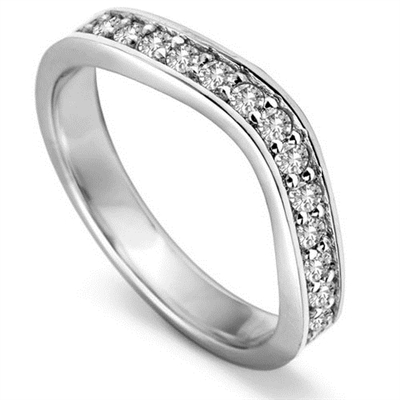
Halo settings sit higher and wider. You'll almost certainly need a shaped or contoured band that curves around the halo — a straight band will either gap badly or not sit at all.
Trilogy / Three Stone
Side stones change the profile significantly. A fitted shaped band works best; alternatively, wear the bands on opposite hands for a more contemporary look.
Vintage or Art Deco
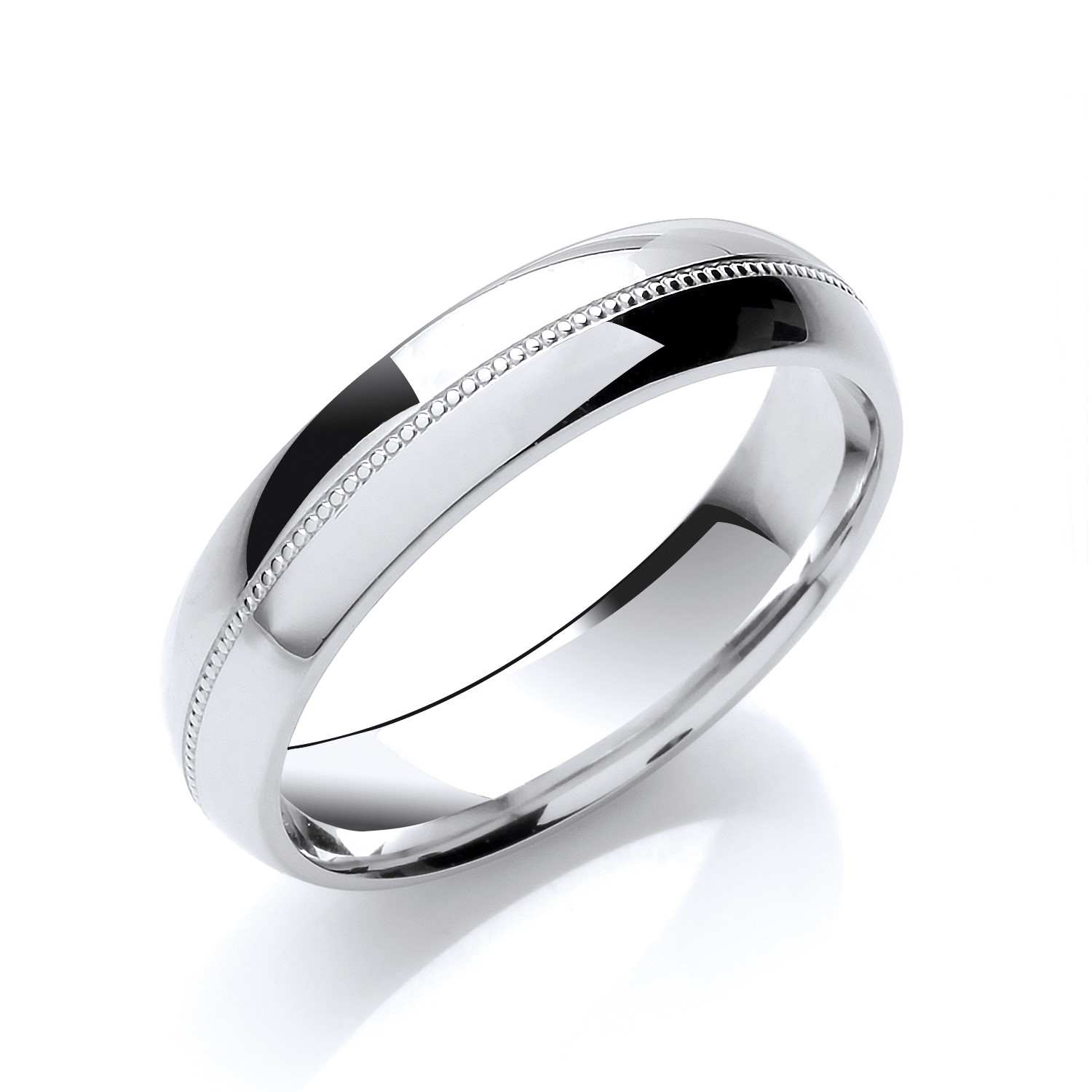
A plain band in matching metal lets the engagement ring's detail breathe. Or lean into the theme with a milgrain-edged or vintage-inspired diamond band for a fully considered look.
Low-Set / Bezel
Low-profile settings are among the easiest to match. A straight band in the same metal sits beautifully flush. Consider a diamond eternity band if you want equal presence on both sides.
Browse women's shaped wedding rings and diamond wedding rings for women to find a style that works with your engagement ring profile.
Women's Wedding Ring Styles: What's Working in Summer 2026
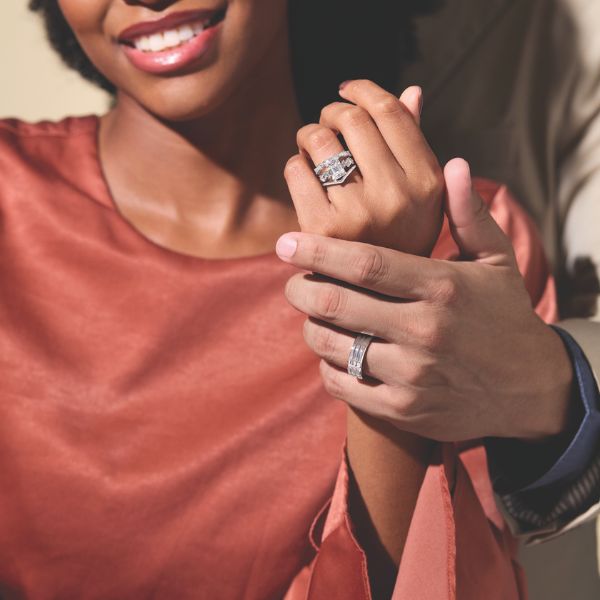
Wedding bands have come a long way from the plain gold circle. In summer 2026, the most sought-after women's styles are those that feel personal, considered and genuinely beautiful in their own right — not just a supporting act for the engagement ring.
Statement Diamond Bands
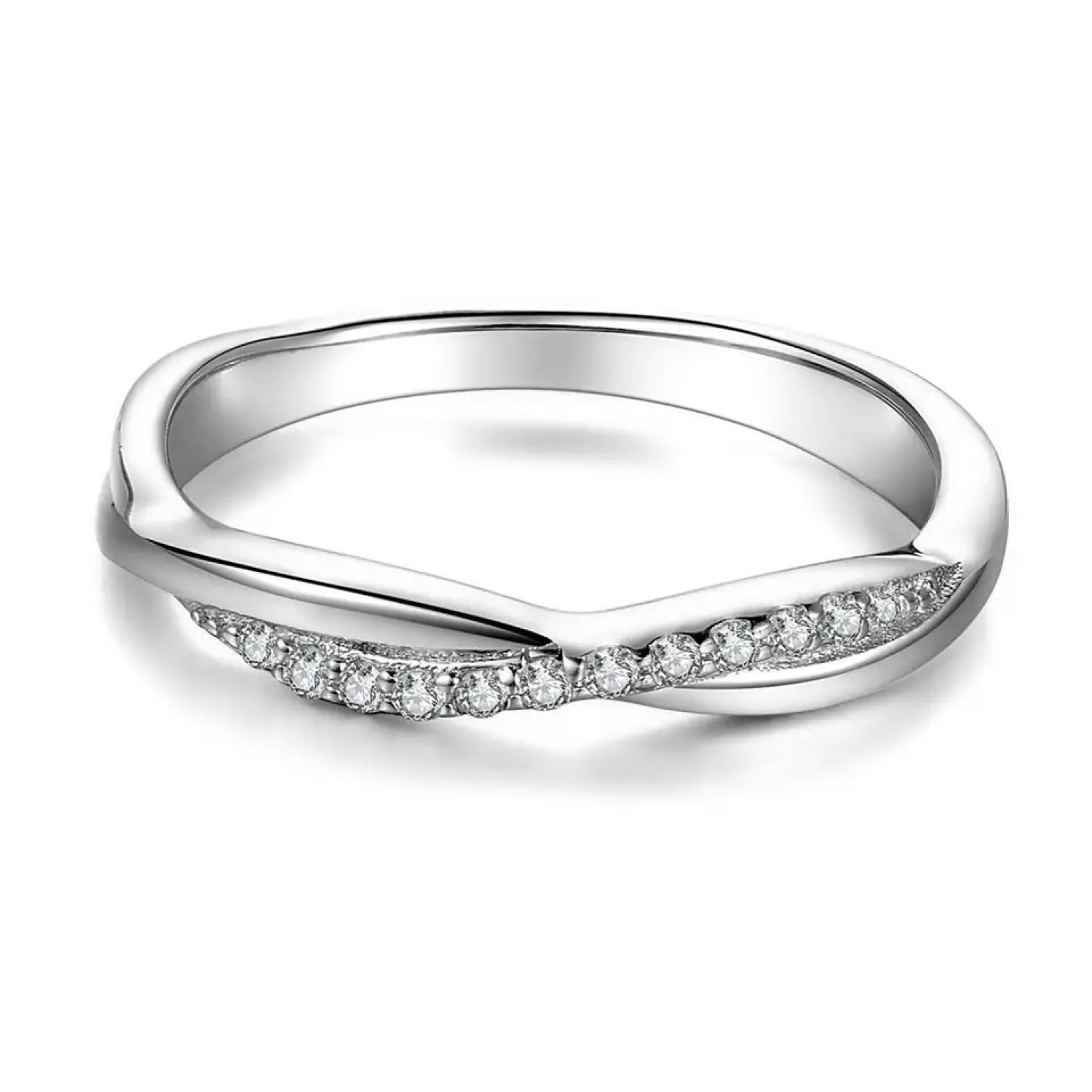
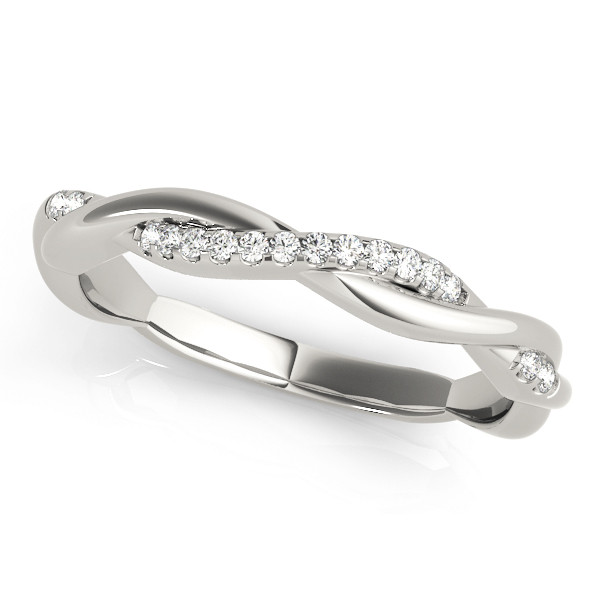
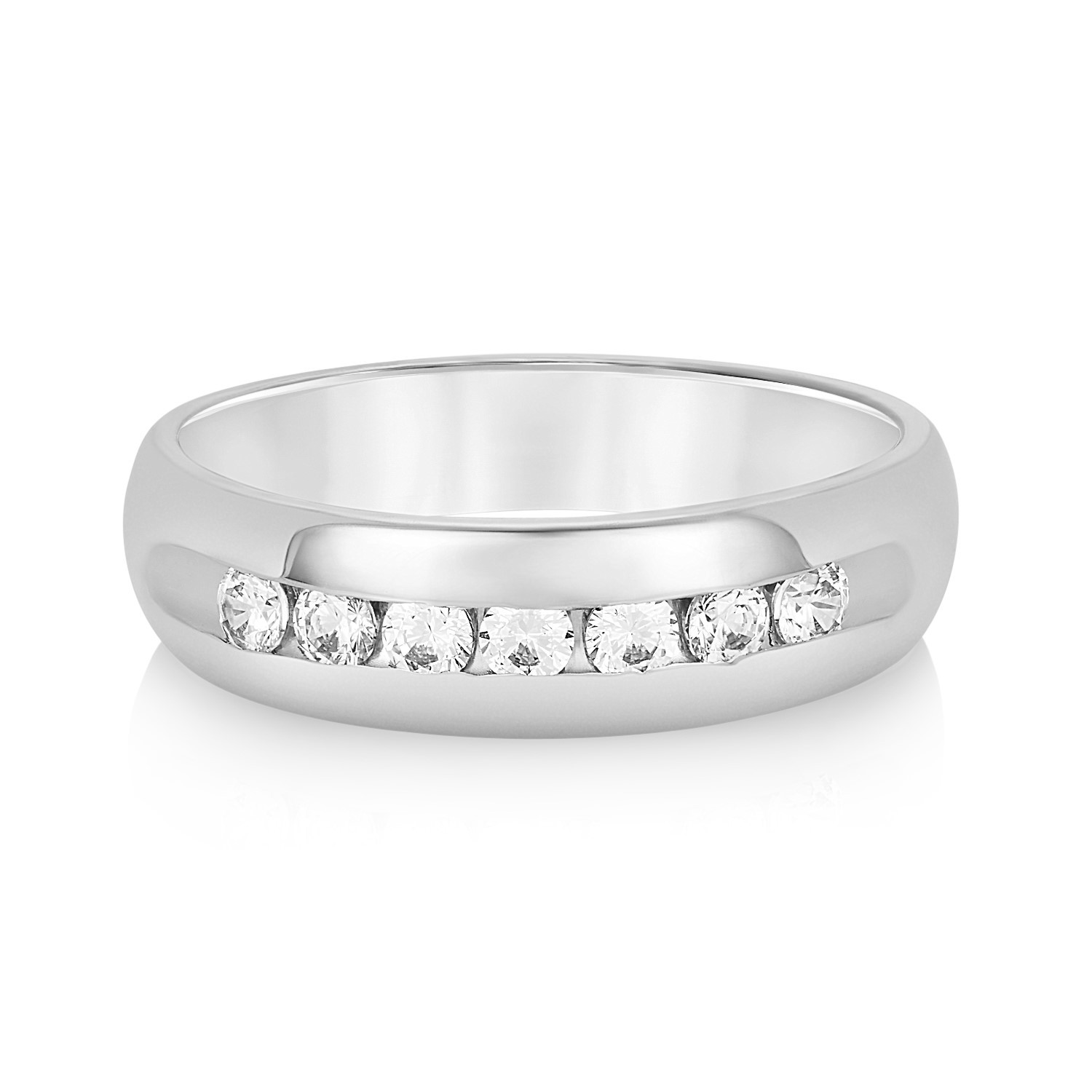
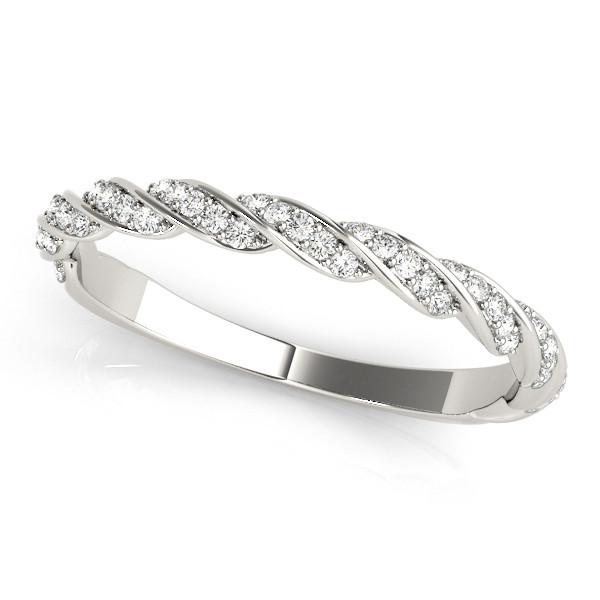
Diamonds are moving from accent to centrepiece on wedding bands. A full pavé or channel-set diamond wedding ring makes a confident statement, especially when the engagement ring is a solitaire and the band provides the sparkle. Look for consistent colour and clarity across the full band — this is where lab-grown diamonds genuinely excel over mined stones at the same price point.
Shaped / Contoured Bands
A shaped wedding ring is cut or curved to fit around the profile of a specific engagement ring. It eliminates the gap that appears with a straight band alongside a raised setting, and creates a seamless, bespoke look that flat bands simply cannot replicate. If your engagement ring has any kind of profile — a raised centre stone, side stones, or a wave setting — a shaped band is almost always the better choice.
Vintage-Inspired Designs
Searches for vintage wedding rings have surged significantly in 2026. Milgrain edging, fine engraved detail and antique-cut stones (particularly emerald and asscher cuts) are appearing on bands that feel genuinely heirloom in character. These work especially well in yellow gold, where the warmth of the metal amplifies the period feeling.
Plain Polished Bands
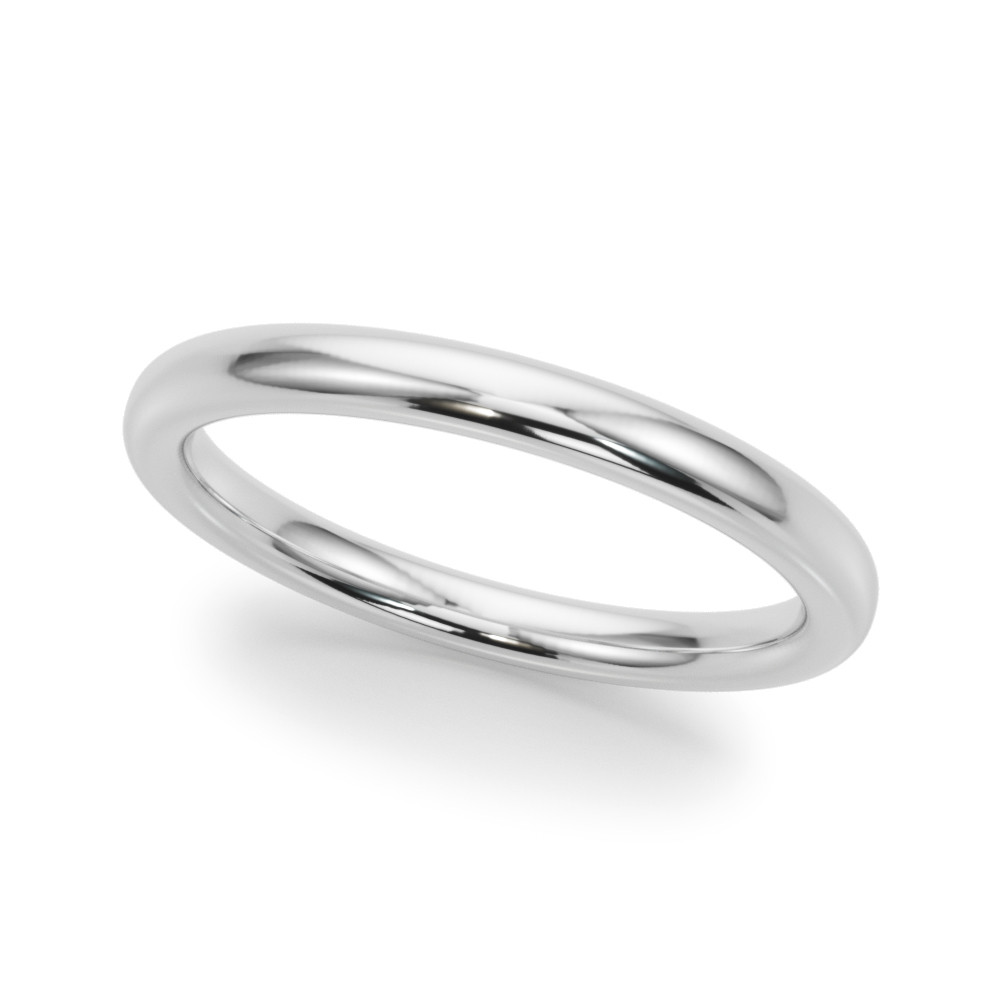
Never underestimate the power of a perfectly made plain band. When the engagement ring is very detailed or heavily set, a slim polished band in the same metal is often the most elegant choice — and the one that looks best in photographs. The key is quality of finish: the metal should be flawlessly polished, the hallmark clearly struck, and the fit absolutely precise.
Browse Women's Wedding Rings
Men's Wedding Bands: Beyond the Plain Gold Ring
Men's fine jewellery is having a proper moment in 2026, and wedding bands are leading that change. The plain 9ct gold band is no longer the automatic default — and that is a good thing. A wedding band is the one piece of jewellery most men will wear every day for the rest of their lives, so it deserves at least as much thought as any other purchase they'll make this year.
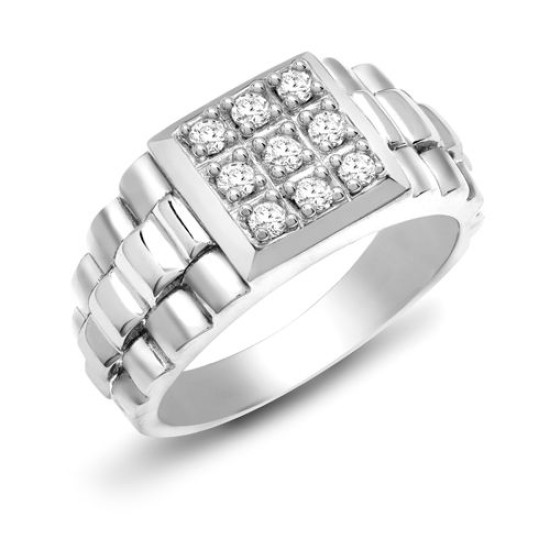
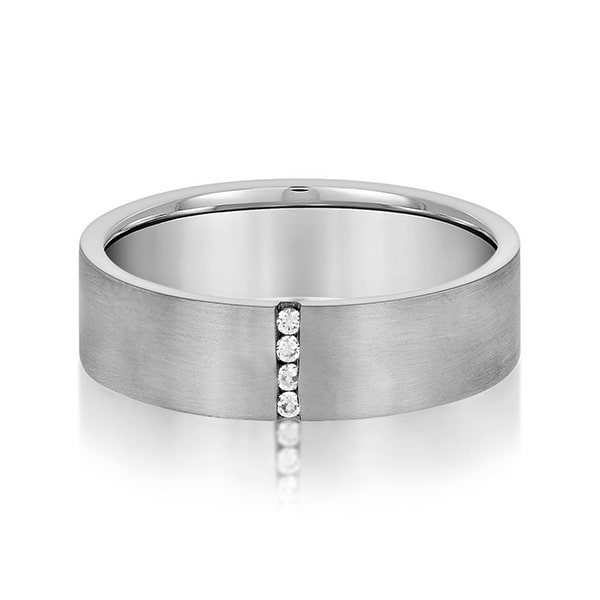
Diamond-Set Men's Bands
A men's diamond wedding band — whether channel-set, bezel-set or flush-set — is sophisticated without being flashy. A single row of small lab-grown diamonds in an 18ct gold or platinum band is visually understated on the hand but unmistakably fine jewellery when you look closely. Perfect for the man who wants something above the ordinary without anything that reads as overtly jewellery-forward.
Contemporary Plain Bands
Contemporary men's wedding bands in heavier gauges, wider widths and interesting finishes (brushed, satin, hammered) are growing in popularity. A wider band in 18ct yellow gold or platinum feels substantial and architectural — very different in character from a slim traditional band. This is the direction many style-conscious grooms are heading in 2026.
Mixed Metal & Two-Tone
Two-tone bands that combine yellow and white gold are a subtle way to bridge the metal tones if one partner is wearing yellow gold and the other white. They also add visual interest to an otherwise plain band — a stripe of contrast metal running through the centre of a wider band looks genuinely considered.
Browse Men's Wedding Rings
Why Lab-Grown Diamonds Are the Smart Bridal Choice in 2026
If you are buying a diamond wedding band — for a woman or a man — lab-grown diamonds deserve serious consideration. Not as a compromise, but as a genuinely better option for most buyers in 2026.
A lab-grown diamond is a real diamond. It is not cubic zirconia, not moissanite, not glass. Grown using Chemical Vapour Deposition (CVD) or High Pressure High Temperature (HPHT) methods, a lab-grown diamond is chemically, physically and optically identical to a mined diamond. The same carbon structure, the same hardness (10 on the Mohs scale), the same refractive index — and graded by the same independent laboratories, IGI and GIA, using the same 4Cs criteria.
- 50–70% more for your money. The same spend that buys a 0.50ct total weight mined diamond band typically buys a 0.75–0.85ct lab-grown equivalent. On a pavé wedding band with 20+ stones, that difference is visible and meaningful.
- Exceptional consistency. Lab-grown diamonds are grown in controlled conditions, so colour and clarity matching across a full band is easier to achieve — resulting in a more uniform, beautiful finished piece.
- Full provenance transparency. Every Sunshine Diamonds lab-grown stone is IGI or GIA certified. You know the cut, colour, clarity and carat weight independently verified — not just claimed.
- Ethical credentials. Lab-grown diamonds have no association with conflict mining. For many couples in 2026, this is a deciding factor — particularly when buying for a lifetime symbol of commitment.
- UK hallmarked settings. The diamonds are only as valuable as the metal they sit in. Every Sunshine Diamonds band is submitted to a UK Assay Office and carries the hallmark — your legal guarantee of metal purity.
Choosing Your Metal: The Complete Summer 2026 Guide
Metal choice is the foundation of every wedding band decision — it affects the look, the durability, the skin comfort, and how the band wears over decades. Here is the honest guide to each option:
18ct Yellow Gold
The clear trend leader for 2026. Yellow gold has been building momentum since 2023 and is now firmly the most directional choice for bridal jewellery. Rich, warm, and genuinely timeless — it photographs beautifully in summer light and works across all skin tones. At 18ct (750 parts per thousand), it is fine jewellery standard: durable, hallmarked, and infinitely superior to 9ct gold for everyday wear. If you are unsure which metal to choose, yellow gold is the safe but stylish answer for 2026.
18ct White Gold
Cool, bright and contemporary. White gold pairs exceptionally well with colourless lab-grown diamonds and suits brides who prefer a crisper, modern aesthetic. Sunshine Diamonds' 18ct white gold is nickel-free, making it comfortable for sensitive skin. Note that white gold will need rhodium re-plating every few years to maintain its bright white finish — a minor consideration for a piece worn daily over decades.
Platinum
The premium choice for durability. Platinum is naturally white (no plating needed), hypoallergenic, and denser than gold — it feels substantial on the finger in a way gold simply does not. It develops a patina over time rather than scratching cleanly, which many wearers come to love as a sign of a life lived. For anyone planning to wear their band without removing it — sleeping, exercising, everything — platinum is the most practical fine metal available.
18ct Rose Gold
A romantic, warm option that has had a strong run of popularity. Rose gold works particularly well for shaped or contoured bands, and pairs beautifully with pale skin tones. If your engagement ring is rose gold, the band choice is easy; if it is yellow or white, you can mix intentionally — but get the combination right before you commit.
Getting the Fit Right
Wedding ring sizing is one of the most common sources of last-minute panic — and entirely avoidable with a little planning. Fingers change size throughout the day (they are larger in the evening and in warm weather), which is particularly relevant for a summer wedding.
- Get sized properly. Visit a jeweller in person for an accurate ring size measurement — online sizing guides using string or paper are notoriously unreliable. If you are buying online, order a ring sizer first.
- Size in the afternoon. Fingers swell slightly in heat and over the course of the day. Getting sized in the afternoon gives you a more accurate everyday size than a morning measurement.
- Account for summer. If your wedding is in July or August, size slightly on the larger end — fingers swell in heat, and a ring that fits perfectly in February can feel tight in a warm marquee.
- Width affects fit. A wider band (5mm+) will feel tighter than a narrow band in the same nominal size. Size up half a size for bands wider than 4mm.
- Shaped bands need special attention. A contoured band must be sized together with the engagement ring it is made to sit alongside — the two measurements interact.
- Allow for resizing. Most 18ct gold and platinum bands can be resized up or down by 1–2 sizes. Full eternity rings (where stones run all the way around) cannot be resized — get the measurement absolutely right before ordering.
Step-by-Step: How to Choose Your Wedding Rings for Summer 2026
- Confirm the engagement ring first. Everything about the wedding band — the shape, the metal, the width — flows from the engagement ring. If the engagement ring is not yet finalised, do not choose the wedding band.
- Identify whether you need a shaped band. Hold the engagement ring against your finger. Is there a gap either side of the setting? Does a straight band sit flat or rock on the profile? If there is any gap or instability, you need a shaped wedding ring.
- Decide on your metal and match it. Match the wedding band metal to the engagement ring metal unless you are deliberately mixing. Confirm whether you want yellow gold, white gold, rose gold or platinum — and check that option is available in the style you want.
- Choose your diamond preference. Plain band or diamond-set? If diamond-set, consider lab-grown for the value advantage. Decide on setting style: pavé, channel, bezel or flush-set each has a different character and durability profile.
- Get sized correctly. Visit a jeweller in person in the afternoon. Size for the width of band you are buying, not the size of your engagement ring (they may differ).
- Consider engraving. A date, initials, a short phrase — engraving adds a layer of meaning that no one else sees. Factor in 1–2 extra weeks of lead time.
- Order with time to spare. Place your order at least 6–8 weeks before your wedding date. 10–12 weeks if bespoke, shaped, or engraved. Do not leave this to the last four weeks — this is not a risk worth taking.
- Try both rings on together before the day. When your wedding band arrives, put it on alongside your engagement ring and wear them both for a full day. Check the fit, the gap, and the comfort. There is still time to adjust before the ceremony — there is not on the day.
7 Common Wedding Ring Mistakes — and How to Avoid Them
These are the things we see couples get wrong most often. All of them are easily avoidable with a little advance planning.
- Buying the band without trying it next to the engagement ring. The two rings need to be worn together before purchase — not just held side by side. The gap, the height difference, and the balance only become apparent on the finger.
- Choosing the wrong width. A band that looks slim in a product photograph can feel very wide on a narrow finger. Try multiple widths in person.
- Forgetting to allow time for sizing and engraving. Six to eight weeks minimum for standard orders; ten to twelve for bespoke. Jewellers in peak summer season book up quickly.
- Getting sized in the morning in winter. Fingers are smallest in cold weather and in the morning. Size in the afternoon and in a warmer room — especially relevant for summer weddings where fingers will be warm on the day.
- Assuming a full eternity ring can be resized. It cannot. Full eternity rings with stones running all the way around have no metal to work with during resizing. Get the size exactly right before ordering, and accept that future resizing is not an option.
- Prioritising the wedding day look over everyday wearability. You will wear this ring every day for decades. A ring that photographs beautifully but catches on everything, feels too tight, or requires constant maintenance is the wrong choice for daily life.
- Dismissing lab-grown diamonds as "not real." They are chemically, physically and optically identical to mined diamonds. Dismissing them means paying significantly more for the same stone — a particularly poor decision on a piece you are buying specifically to wear forever.
Comparison Tables
Wedding Band Styles — Which Suits You?
| Style | Best Engagement Ring Match | Metal Options | Resizable? | Best For |
|---|---|---|---|---|
| Plain polished band | Any — especially detailed rings | All metals | Yes | Minimalist, classic brides |
| Pavé diamond band | Solitaire, bezel, low-set | White/yellow gold, platinum | Yes (half eternity) | Maximum sparkle, everyday glamour |
| Shaped / contoured band | Halo, cluster, high-set, trilogy | All metals | Yes | Any ring with a raised profile |
| Channel-set diamond band | Solitaire, contemporary rings | White/yellow gold, platinum | Yes (half channel) | Clean, modern look with security |
| Full eternity band | Low-set, bezel, contemporary | All metals | No — size carefully | Statement, anniversary upgrade |
| Vintage / milgrain band | Vintage/Art Deco engagement rings | Yellow/rose gold | Yes | Heritage and heirloom aesthetic |
Metal Comparison for Wedding Rings
| Metal | Look | Durability | Hypoallergenic? | Maintenance | 2026 Trend Rating |
|---|---|---|---|---|---|
| 18ct Yellow Gold | Warm, classic | Excellent | Yes (nickel-free) | Low | ⭐⭐⭐⭐⭐ |
| 18ct White Gold | Cool, bright | Excellent | Yes (nickel-free) | Re-plate every few years | ⭐⭐⭐⭐ |
| 18ct Rose Gold | Warm, romantic | Excellent | Yes (nickel-free) | Low | ⭐⭐⭐⭐ |
| Platinum | Naturally white | Outstanding | Yes | Minimal (patina develops) | ⭐⭐⭐⭐⭐ |
Lab-Grown vs Natural Diamonds in Wedding Bands
| Factor | Lab-Grown Diamond | Natural (Mined) Diamond |
|---|---|---|
| Real diamond? | Yes — chemically & optically identical | Yes |
| IGI / GIA certified? | Yes | Yes |
| Value for money | 50–70% more carat weight per £ | Higher price for same spec |
| Colour consistency across band | Excellent — easier to match | Harder at lower price points |
| Ethical provenance | Fully traceable, no mining | Varies by supplier |
| Appearance to the naked eye | Indistinguishable | Indistinguishable |
| Best for wedding bands? | Yes — especially pavé & channel sets | Buyers prioritising rarity |
Frequently Asked Questions
Final Thoughts
Your wedding ring is the most-worn piece of jewellery you will ever own. It will be on your finger at breakfast, at work, on holidays, and at every significant moment your life holds from the day you put it on. That makes it worth thinking about properly — not just what it looks like on the day, but how it will wear, how it will feel, and whether it will still look beautiful in twenty years.
For a summer 2026 wedding, the combination that stands out above everything else is a lab-grown diamond band in hallmarked 18ct yellow gold or platinum. It is the most brilliant, the most ethically considered, and the most genuinely good-value choice available. Start with the engagement ring, match the metal and the profile, and give yourself enough lead time to get the sizing, the setting and any engraving exactly right.
Get those three things right — the fit, the style, and the timing — and you will put on a ring on your wedding day that you will still love reaching for decades later.
Browse the full wedding ring collection at Sunshine Diamonds, explore diamond wedding rings for women, men's diamond wedding bands, or visit our wedding ring sale for exceptional value on hallmarked pieces. Ready to find the right ring? Book a consultation with our team and we'll help you choose with confidence.