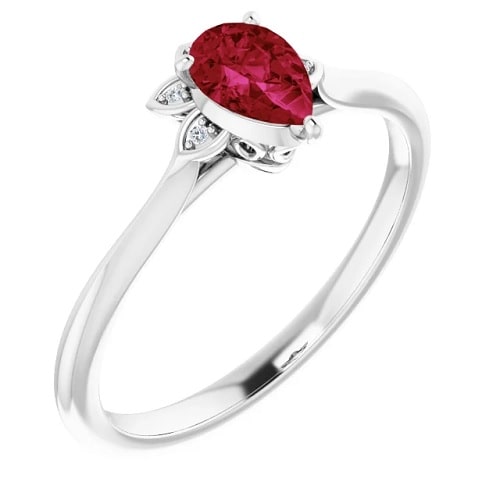
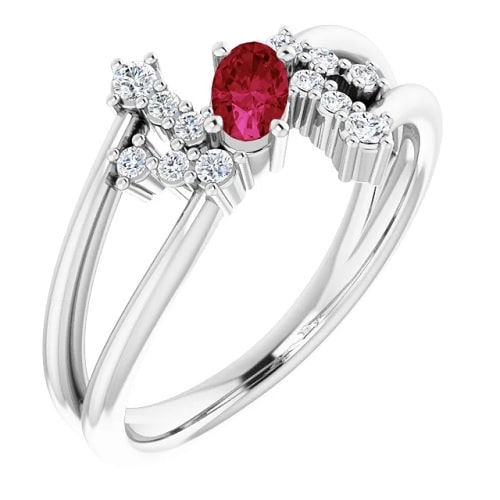
Ruby Rings Buying Guide
.jpg)
Quick Summary
- Pigeon blood red is the most prized ruby shade, but pink-red and purple-red tones are equally genuine and far more affordable
- Rubies rank 9 on the Mohs scale — second only to diamond — making them a genuinely practical choice for daily wear
- Most rubies on the market are heat-treated to improve colour; this is standard, accepted practice and nothing to be wary of
- Lab-grown rubies are chemically and optically identical to natural stones, typically for a fraction of the price
- UK ruby ring prices range from around £130 for a petite lab-grown stone to £15,000+ per carat for top natural pigeon blood rubies
- Always ask for independent gemstone certification on any natural ruby over roughly 0.50ct
- Halo and three-stone settings make a smaller ruby look more substantial without increasing the carat spend
- Every Sunshine Diamonds ruby ring is UK hallmarked and supplied with full gemstone documentation
Content Quicklinks
- - What Are Rubies?
- - A Brief History of Rubies in Jewellery
- - Where Do Rubies Come From?
- - The 4 Cs of Buying a Ruby
- - Natural, Treated & Lab-Grown Rubies Explained
- - Ruby Ring Styles & Settings
- - Why Choose a Ruby Ring?
- - Ruby Ring Price Guide (UK)
- - Certification & Buying Tips
- - Step-by-Step: Choosing Your Ruby Ring
- - Common Mistakes to Avoid
- - Caring for Your Ruby Ring
- - Ruby vs Other Red Gemstones
- - FAQs
- - Final Thoughts
Gemstones have been part of human adornment since the earliest civilisations — Mesopotamia, Rome, and ancient India — and few have held their status quite like the ruby. It is the gemstone of passion and power, hard enough for a lifetime of wear, and rare enough that buying one properly takes a little knowledge. This guide covers everything from what a ruby actually is to how it's graded, what it costs in the UK in 2026, and exactly how to choose the right ring with confidence.
What Are Rubies?
A ruby is a precious gemstone from the corundum mineral family – the same family as sapphire – coloured a vivid red by trace amounts of chromium and ranked 9 on the Mohs hardness scale, second only to diamond. That hardness is not a minor detail: it is precisely what makes a ruby suitable for a ring you intend to wear every day, unlike many softer coloured gemstones that need to be reserved for occasional pieces.
The finest rubies display a deep, pure red known in the trade as "pigeon's blood" — a colour so prized it can multiply a stone's value several times over. Beyond aesthetics, rubies have long been credited with symbolic meaning: passion, courage, protection and enduring love, which is exactly why they remain a popular choice for engagement and anniversary rings today.
A Brief History of Rubies in Jewellery
Ruby's history stretches back thousands of years. In ancient India it was named "ratnaraj" — king of gemstones — and reserved for royal adornment. As trade routes opened along the Silk Road in the Middle Ages, rubies travelled west and began appearing in the crowns, brooches and necklaces of European nobility, prized as a symbol of wealth and protection in battle.
The 19th century brought advances in gem-cutting that let jewellers showcase ruby's colour more dramatically, and the Art Deco period set rubies into bold, geometric designs that cemented their place in high fashion. Today, that same stone sits just as comfortably in a modern engagement ring or a contemporary statement piece — the appeal has never really gone away.
Where Do Rubies Come From?
Rubies form under extremely specific high-pressure, high-temperature geological conditions, which is part of why fine examples are genuinely rare. Myanmar's Mogok Valley has long produced the most celebrated rubies in the world, prized for their depth of colour and clarity, though political instability has significantly reduced new supply from the region in recent years. Thailand remains a major source — and the centre of the world's ruby heat-treatment trade — while Madagascar and Mozambique have grown into important, increasingly well-regarded sources over the past two decades. Smaller quantities also come from India (Jammu & Kashmir) and parts of East Africa, including Kenya.
The 4 Cs of Buying a Ruby: Colour, Clarity, Cut & Carat
Unlike diamonds, where cut and carat tend to dominate value, ruby pricing is led overwhelmingly by colour. Here's how each of the 4Cs applies specifically to rubies.
Colour
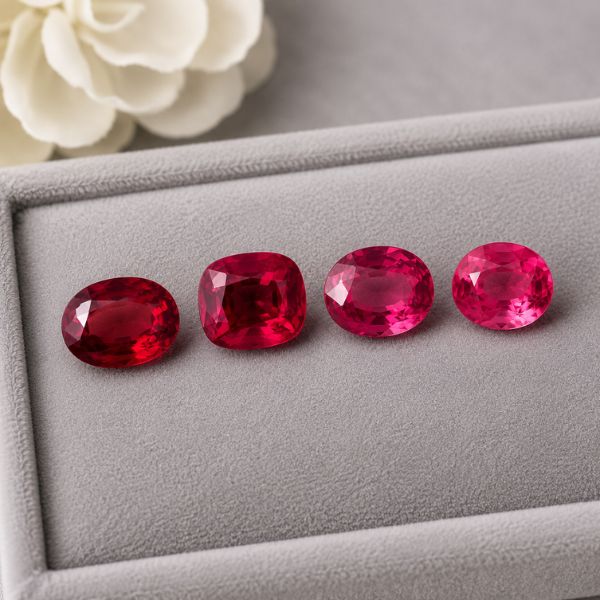
Colour is the single biggest driver of a ruby's value. The most desirable shade is a vivid, slightly purplish-red known as "pigeon blood" — pure, saturated, and glowing rather than dark or brownish. Rubies also occur in lighter pinkish-reds and deeper purplish tones; both are completely genuine and simply sit at a different point on the colour – and price – spectrum.
Clarity
Clarity refers to a stone's internal inclusions. Rubies are almost never perfectly clean — natural inclusions, sometimes called "silk", are expected and, in moderation, don't detract from a stone's beauty or durability. What matters is whether inclusions reach the surface (which can affect durability) or visibly interrupt the stone's brilliance. Eye-clean rubies with minimal visible inclusion are rarer and command a premium.
Cut
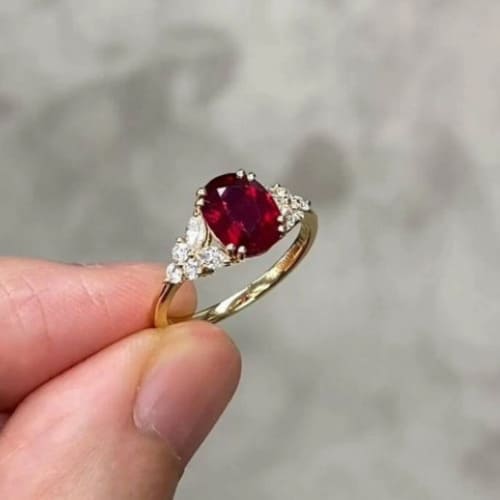
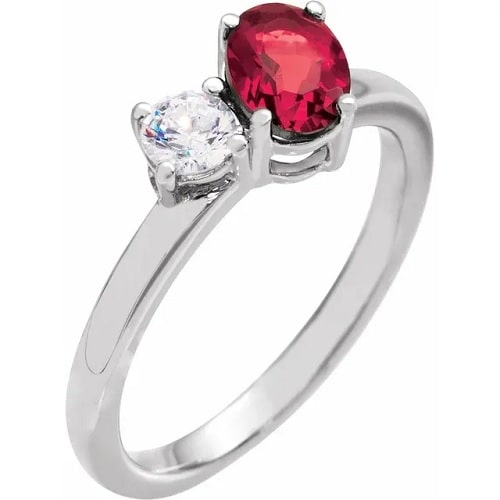
Cut determines how well a ruby reflects light. Oval and cushion cuts are the most popular choices because they tend to retain more weight from the rough stone while still showing strong brilliance; round and emerald cuts are also widely available. A well-proportioned cut maximises colour and sparkle — a poorly cut ruby can look dull even with excellent natural colour.
Carat
Carat weight matters, but less predictably than with diamonds, because colour quality can outweigh size in determining price. A smaller ruby with vivid, even colour is often worth more per carat than a larger stone with a duller or overly dark tone. As a rough guide, fine rubies above 2 carats are genuinely scarce, which is why price increases sharply, rather than steadily, as size grows.
Natural, Treated & Lab-Grown Rubies Explained
This is one of the most important — and most commonly skipped — parts of buying a ruby. Almost every ruby on the market has been treated in some way, and lab-grown rubies are an increasingly popular, completely legitimate alternative. Here's the honest breakdown.
| Type | What It Means | Price vs Natural Unheated | Best For |
|---|---|---|---|
| Natural, unheated | Formed in the earth, no colour treatment. The rarest and most valuable category. | Baseline — the premium category | Collectors, investment pieces, milestone gifts |
| Natural, heat-treated | Formed in the earth, heated to improve colour clarity — the industry standard, used on the vast majority of rubies sold worldwide. | Typically 50–75% less | Most engagement and fashion rings |
| Lab-grown ruby | Same chemical composition (aluminium oxide with chromium) grown in a controlled environment rather than mined. | Typically 70–90% less | Larger, bolder stones on a sensible budget |
| Glass-filled composite | Heavily fractured natural ruby filled with lead glass to improve clarity. Not considered a true gemstone investment. | A small fraction of the cost — often just a few pounds per carat | Avoid unless clearly disclosed and priced accordingly |
Ruby Ring Styles & Settings
If you're choosing a ruby engagement or dress ring, the setting matters as much as the stone. Here's a quick guide to the most popular styles.
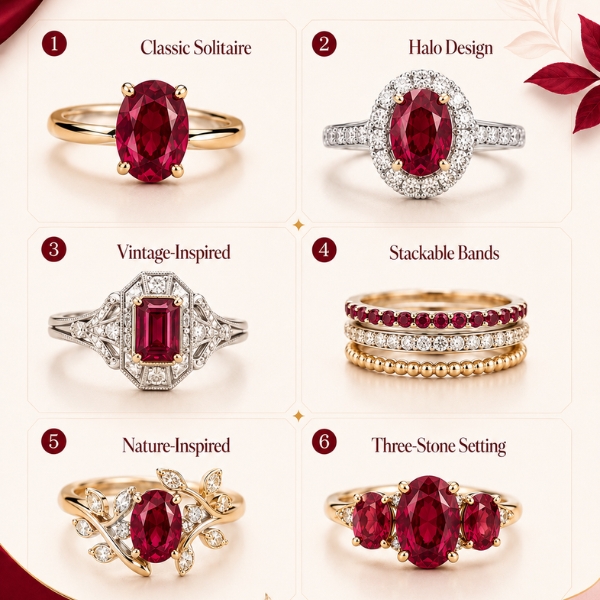
Classic Solitaire
A single high-quality ruby in a simple gold or platinum band. Timeless, and it lets the colour of the stone do all the talking.
Halo Design
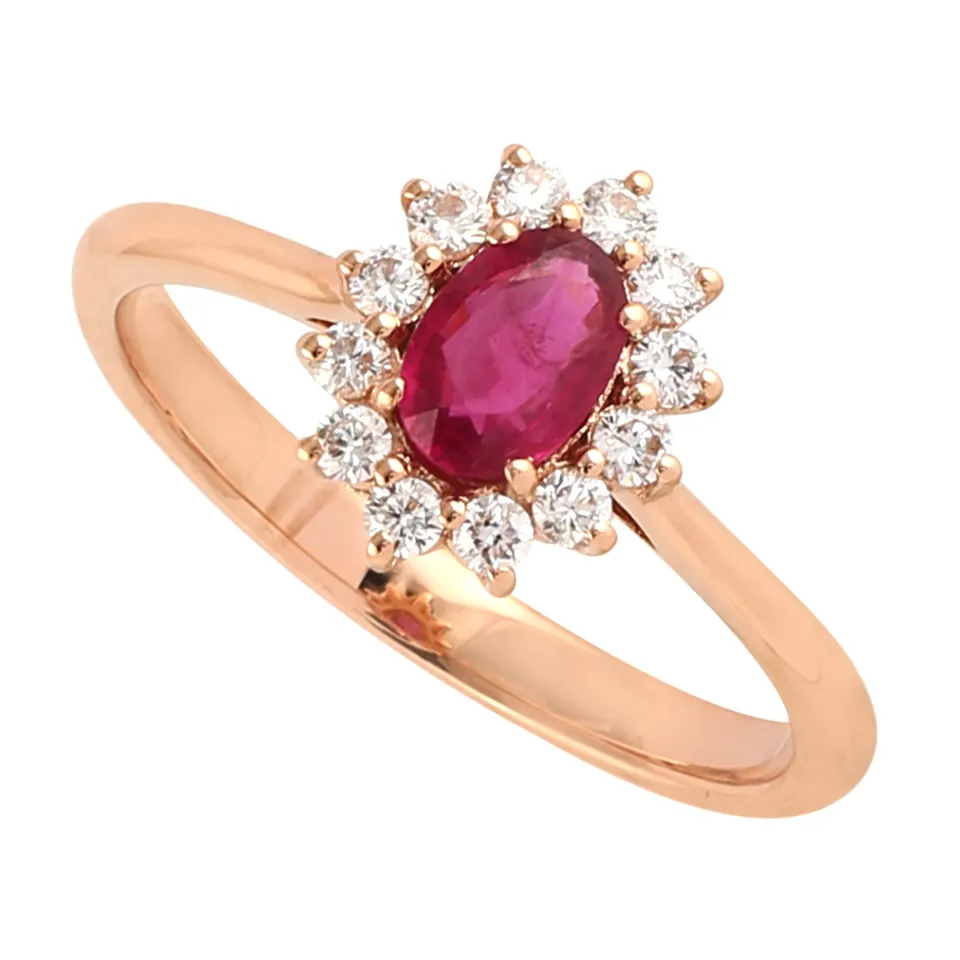
A ruby surrounded by a halo of small diamonds. Adds brilliance and visually increases the size of the centre stone — a smart choice on a tighter budget.
Vintage-Inspired
Intricate filigree or Art Deco detailing with unique stone shapes. Suits buyers looking for something with more character than a contemporary setting.
Stackable Bands
A slim ruby band mixed with other coloured stones or plain metal bands — a modern, personal approach that can be built up over time.
Nature-Inspired
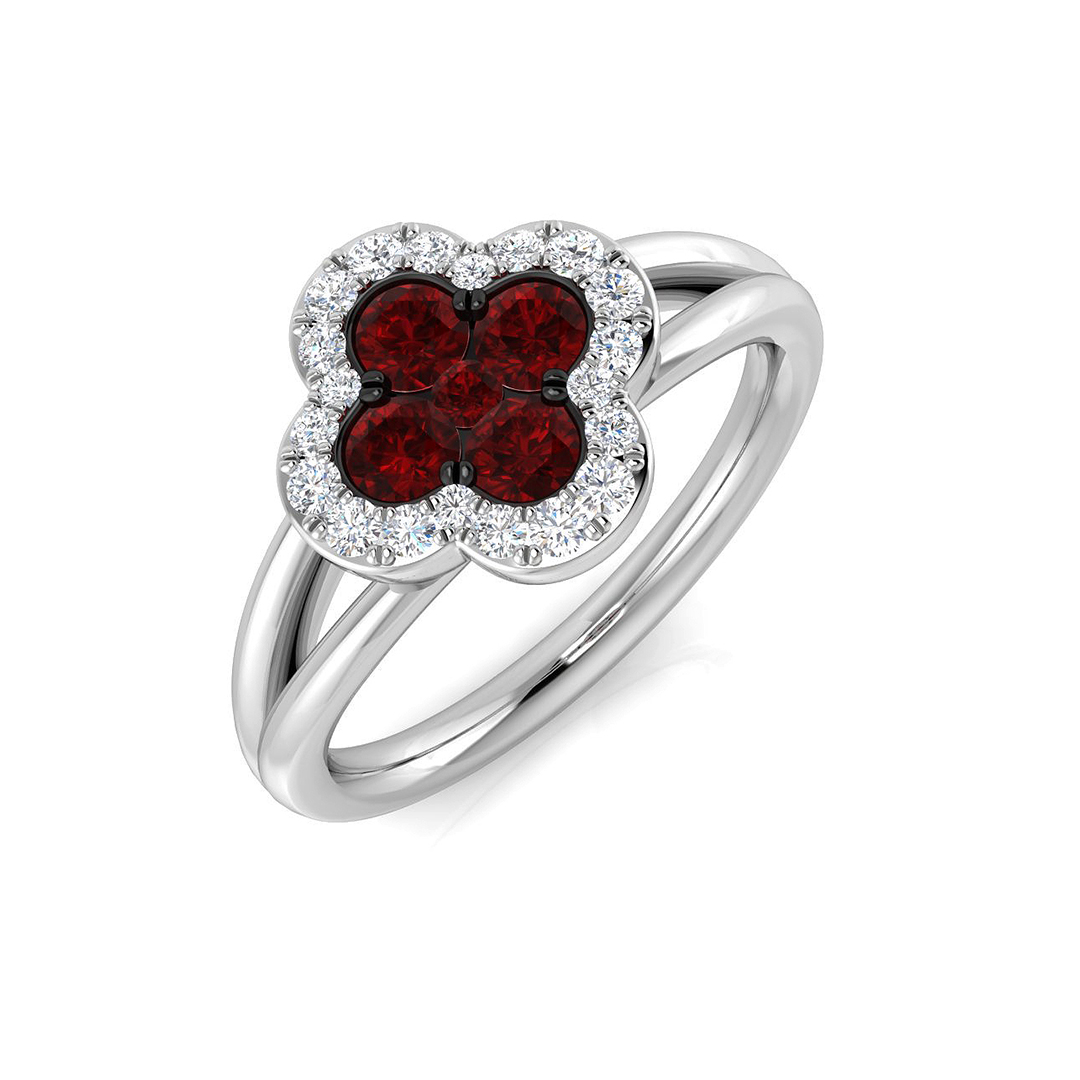
Floral or organic motifs — leaves, vines, petals — surrounding the ruby. A romantic, slightly less formal alternative to a traditional setting.
Three-Stone Setting
A trio of rubies, traditionally read as past, present and future. A meaningful and visually striking choice for an anniversary or engagement ring.
Why Choose a Ruby Ring?
- Colour that stands out. A rich, saturated red reads as confident and distinctive against both white and yellow metals.
- Genuine symbolism. Rubies are closely tied to passion, strength and commitment — a meaningful alternative to a traditional diamond engagement ring.
- Built to last. At 9 on the Mohs scale, a ruby can comfortably handle daily wear for decades.
- Genuine rarity at the top end. Fine, vivid rubies — particularly unheated stones — are rarer than diamonds of equivalent quality.
- Real flexibility on style. From a minimalist solitaire to an elaborate vintage design, ruby suits almost any aesthetic.
Ruby Ring Price Guide (UK)
Ruby pricing has one of the widest spreads of any major gemstone — driven far more by colour quality and treatment status than by size alone. Here's a realistic guide to what your budget buys in 2026.
| Budget | What to Expect | Best Style Choice |
|---|---|---|
| Under £200 | Petite lab-grown ruby, 0.10–0.30ct, set in 9ct or 18ct gold | Solitaire or halo |
| £200–£500 | Lab-grown ruby 0.50ct+, or small natural heat-treated stone, fair colour | Halo or three-stone |
| £500–£1,200 | Natural heat-treated ruby 0.50–1.00ct, good even colour, 18ct gold or platinum | Solitaire or vintage-inspired |
| £1,200–£3,000 | Natural heat-treated ruby 1.00–2.00ct with strong "pigeon blood"-leaning colour, certified | Statement solitaire or halo |
| £3,000–£15,000+ per carat | Natural unheated rubies with certified pigeon blood colour — the collector and investment tier | Bespoke or solitaire, certificate essential |
Certification & Buying Tips: What to Look For
When buying a ruby — particularly anything above roughly £500 — prioritise colour first, then clarity, then cut, and confirm carat last. Look for vivid, even, pure red, ideally close to that pigeon blood shade. Ask plainly whether the stone is heat-treated (expect yes, for the vast majority of stones) and whether it has been glass-filled (this should be clearly disclosed and reflected in the price).
For anything natural and above around 0.50ct, ask for an independent gemstone report from a recognised laboratory — GIA, GRS, AGL, Gübelin or SSEF are the names to look for. A genuine, reputable jeweller will never hesitate to provide one, or to explain a stone's treatment history clearly and without prompting.
Step-by-Step: Choosing Your Ruby Ring
- Set your budget first. This single decision determines whether you're shopping natural heat-treated, lab-grown, or the natural unheated collector tier.
- Decide: natural or lab-grown? If size and budget matter more than provenance, lab-grown gives significantly more stone for the same spend.
- Prioritise colour over carat. A smaller ruby with vivid, even red will almost always look better — and hold value better — than a larger, duller stone.
- Check clarity and ask about treatment. Confirm heat treatment status and specifically rule out undisclosed glass-filling.
- Choose a setting that suits how it will be worn. Halo and channel settings protect the stone well for daily wear; a solitaire claw setting maximises brilliance for occasional pieces.
- Request documentation. For any natural stone over 0.50ct, ask for a certificate from a recognised gemmological laboratory.
- Get the ring size right before ordering, particularly for fully set or eternity-style ruby bands that are harder to resize.
Common Mistakes to Avoid When Buying a Ruby Ring
- Assuming "untreated" always means better. Heat-treated rubies are not lesser stones — they are the industry standard and represent excellent value at every price point.
- Skipping certification on a higher-value piece. Without a lab report, you have no independent confirmation of treatment status, origin or quality — and no protection if a claim turns out to be inaccurate.
- Judging colour from photos alone. Ruby colour is notoriously difficult to capture accurately in photography and under different lighting — see the stone in person, or under daylight-equivalent lighting, wherever possible.
- Choosing a fragile setting for an active lifestyle. A high claw solitaire looks stunning but is more vulnerable to knocks than a channel or bezel setting for daily wear.
- Not asking specifically about glass-filling. A large, clean, inexpensive "ruby" is a red flag worth a direct question before you buy.
- Buying in a rush. A ruby ring — especially an engagement ring — deserves the time to compare colour, clarity and setting in person before committing.
Caring for Your Ruby Ring
Thanks to its 9 Mohs hardness, a natural or lab-grown ruby is one of the more forgiving gemstones for daily wear. Clean it regularly with warm water, a mild soap and a soft brush, and dry with a lint-free cloth. Most heat-treated and lab-grown rubies can be safely cleaned with an ultrasonic or steam cleaner — but glass-filled composite stones cannot, as the heat and vibration can damage the filling. If you're ever unsure of a stone's treatment history, stick to gentle hand cleaning.
Store ruby rings separately from softer jewellery, since a ruby's hardness means it can scratch gold, pearls and softer gemstones if they're left to knock together in the same box. Remove rings before heavy manual work, gym sessions or swimming in chlorinated water, and have prongs checked annually by a jeweller to keep the stone secure.

Ruby vs Other Red Gemstones
If budget or durability is steering you toward alternatives, here's how ruby compares with the other red gemstones you're most likely to come across.
| Gemstone | Mohs Hardness | Relative Price | Best For |
|---|---|---|---|
| Ruby | 9 | Highest at fine quality | Engagement rings, daily wear, lasting value |
| Red Spinel | 8 | Significantly lower than ruby | Buyers who want a genuine, untreated natural stone on a lower budget |
| Rhodolite Garnet | 7–7.5 | Lowest of the group | Budget-friendly fashion jewellery, occasional wear |
| Pink/Red Tourmaline | 7–7.5 | Mid-range | Softer pink-red tones, statement earrings and pendants |
Continue Browsing
Note to client: confirm the above category URLs against the live sitemap (sunshinediamonds.com/sitemap.xml) before publishing — placeholders used here.
Frequently Asked Questions
Final Thoughts
Buying a ruby ring well comes down to understanding what you're actually paying for: colour above all, then clarity and cut, with carat as the final consideration rather than the first. Whether you choose a natural heat-treated stone, a lab-grown ruby, or a rare unheated pigeon blood gem, the same rules apply — ask about treatment, request documentation on anything significant, and prioritise the setting that suits how the ring will actually be worn.
Browse the full ruby rings collection at Sunshine Diamonds, or get in touch with our team for guidance on the right stone, setting and budget for you.