The Best Metals for Cartilage Earrings: A UK Fine Jewellery Guide
Quick Summary
- Cartilage heals slower than the lobe — metal quality matters far more here
- Platinum is the safest, most hypoallergenic option for sensitive ears
- Nickel-free 18ct white gold is an excellent, more affordable alternative
- 18ct yellow & rose gold (75% pure) are also widely well-tolerated
- Avoid plated metals — once worn through, the base metal irritates skin
- New piercings need implant-grade titanium; fine metals are for healed piercings
- Every Sunshine Diamonds earring is UK hallmarked & IGI/GIA certified
- Lab-grown diamonds give better consistency & value for matched stud sets
Content Quicklinks
- - Why Cartilage Piercings Are So Sensitive
- - What Makes a Metal Safe for Cartilage Earrings?
- - The Best Metals for Cartilage Earrings
- - New Piercings vs Healed Piercings
- - Metals to Approach with Caution
- - Why UK Hallmarked Earrings Matter
- - Why Lab-Grown Diamonds Are Ideal for Cartilage Earrings
- - Step-by-Step: Choosing Your Cartilage Earrings
- - Styling Cartilage & Hoop Earrings
- - Caring for Your Cartilage Earrings
- - Comparison Tables
- - FAQs
- - Final Thoughts
Love the look of cartilage earrings but find they leave your ear sore, itchy, or slow to heal? Nine times out of ten, the culprit is not the piercing — it's the metal. Cartilage is more delicate than the fleshy lobe: it has a poorer blood supply, heals significantly more slowly, and reacts far more readily to irritants. That means the metal in your cartilage earrings matters more than it would for a simple lobe stud, and choosing well from the start can make the difference between jewellery you forget you're wearing and jewellery you're constantly aware of.
This guide explains exactly which fine metals are kindest to sensitive ears, which to approach with real caution, and how to choose confidently between 18ct gold and platinum for your cartilage jewellery. Whether you're treating yourself to a long-overdue upgrade from fashion jewellery, or buying a thoughtful gift for someone who has struggled with reactive ears, you'll find everything you need here to make the right call.
Why Cartilage Piercings Are So Sensitive
Cartilage is avascular tissue — meaning it has no direct blood supply of its own and relies entirely on surrounding tissue for nutrients and immune response. This single fact explains almost everything about why cartilage piercings behave so differently from lobe piercings. When cartilage is pierced, it heals significantly more slowly than the lobe, and any irritant sitting against it has far more time to provoke a reaction before the body can resolve it.
To put this in perspective: a lobe piercing typically heals in six to eight weeks. A cartilage piercing — whether it's a helix, tragus, conch or rook — can take six months to a year, and sometimes longer, particularly for larger anatomical areas like the conch. During that entire window, the tissue is more vulnerable, more reactive, and less forgiving of anything that doesn't agree with it.
The single most common chemical trigger is nickel — an alloy metal found in a huge proportion of cheaper earrings, including many that are marketed as "gold" or "gold-plated." Nickel ions can leach from the metal surface and penetrate the skin, triggering contact dermatitis: redness, itching, swelling, weeping, and a piercing that simply never seems to fully settle. Many people blame this on the piercing itself, assuming their body has "rejected" it — but in the overwhelming majority of cases, it is the metal, not the piercing, that is the problem.
The EU's Nickel Directive restricts the amount of nickel that can be released from jewellery sold across Europe, and similar standards apply in the UK. But regulation only goes so far — the most reliable way to protect sensitive ears is to choose the right metals from the outset, rather than discovering a sensitivity through months of discomfort.
What Makes a Metal Safe for Cartilage Earrings?
Three factors determine whether a metal is genuinely suitable for long-term cartilage wear: high precious-metal purity, the absence of nickel, and solid construction rather than plating. Understanding each of these will help you evaluate any earring — from any retailer — with confidence.
- High purity. The more precious metal present in the alloy, the less room there is for base metals that might irritate. 18ct gold is 75% pure gold — only 25% is alloy. 9ct gold, by contrast, is just 37.5% pure gold, meaning 62.5% of the metal is other materials, some of which may include nickel. The higher the karat, the lower the overall risk profile.
- No nickel. Some white gold alloys use nickel specifically to achieve their bright white colour — it's an effective whitening agent, but it's also the single most common allergen in jewellery. Sunshine Diamonds' 18ct white gold is alloyed without nickel entirely, removing this risk from the equation rather than simply minimising it.
- Solid, not plated. A plated finish is a thin layer of precious metal — often gold — applied over a base metal core, frequently brass or a nickel alloy. For occasional jewellery, this is a reasonable compromise. For cartilage earrings worn continuously against sensitive, slow-healing tissue, it is not. As the coating wears through daily contact, sleeping, washing and general friction, the base metal underneath becomes exposed directly against the skin — often within months. For long-term cartilage wear, solid fine metal all the way through is always the better, and ultimately, the more economical, choice.
The Best Metals for Cartilage Earrings
Here is the honest breakdown of each fine metal option, what makes it suitable (or not) for sensitive cartilage, and who each one suits best.
Platinum
Platinum sits at the top of the list for cartilage earrings, and for good reason. It is naturally white — no alloying is required to achieve its colour — and it is extremely dense and genuinely hypoallergenic. Unlike white gold, which relies on an alloy mix to achieve its brightness, platinum's whiteness is intrinsic to the metal itself. That means there is no risk of nickel or any other sensitising metal being present in the alloy at all.
Platinum is also one of the most durable precious metals available, which matters significantly for cartilage studs that are often left in place continuously for months at a time. The density of platinum means that settings hold lab-grown diamonds exceptionally securely — there is meaningfully less risk of a stone working loose over time compared with lighter, softer metals.
The only real trade-off is price. Platinum is rarer and considerably denser than gold, so a platinum cartilage stud will typically cost more than its 18ct gold equivalent in the same design. For anyone with highly sensitive skin, a known nickel sensitivity, or a history of reactive piercings, that premium is usually money well spent — it removes the variable entirely rather than minimising it.
18ct White Gold (Nickel-Free)
Sunshine Diamonds' 18ct white gold is alloyed without nickel, which eliminates the most common irritation risk associated with white gold jewellery generally. At 75% pure gold, it is a substantial, beautiful metal that delivers the characteristic cool, bright finish white gold is known for – without the allergy concern that affects so many cheaper or nickel-alloyed white gold pieces.
It is slightly lighter than platinum, which some wearers actively prefer for smaller cartilage pieces worn continuously — less weight on the ear over many hours can make a genuine difference to comfort. If you are considering white gold cartilage earrings from any retailer, the single most important question to ask is whether the alloy is nickel-free. Not all white gold is — at Sunshine Diamonds, it is standard across the entire range.
18ct Yellow Gold
Yellow gold is the classic choice for sensitive ears, and the reasoning is straightforward. At 18ct (75% pure), it has minimal alloy content, is warm in tone, and has been worn safely by generations of people with sensitive ears long before "hypoallergenic jewellery" became a marketing term. The natural warmth of 18ct yellow gold suits a wide range of skin tones, and its hue pairs beautifully with both round brilliant and fancy-cut lab-grown diamonds.
A slim yellow gold cartilage stud or huggie hoop reads as understated and quietly elegant — and because there is no whitening alloy involved at all, the risk of nickel content is essentially eliminated by the metal's composition itself.
18ct Rose Gold
Rose gold gets its characteristic warmth from a copper alloy rather than nickel, which makes it a sound choice for the vast majority of wearers. The pink blush of 18ct rose gold has become one of the most popular choices for curated ear jewellery, particularly for stacking multiple pieces across the lobe and cartilage in a single considered arrangement.
It's worth noting that copper can occasionally cause a reaction in those with a specific copper sensitivity — but this is significantly rarer than nickel sensitivity, which affects a far larger proportion of the population. For the vast majority of people with sensitive ears, 18ct rose gold is both a safe and a genuinely beautiful option.
| Metal | Why It Suits Sensitive Ears | Best For |
|---|---|---|
| Platinum | Naturally white, dense, intrinsically hypoallergenic | Lab-grown diamond studs worn 24/7 |
| 18ct White Gold (nickel-free) | Alloyed without nickel — no nickel release at all | Everyday luxury studs |
| 18ct Yellow Gold | 75% pure gold, minimal alloy, widely well-tolerated | Classic warm-tone cartilage studs |
| 18ct Rose Gold | 75% pure gold, copper-based warm alloy, widely tolerated | Romantic, modern curated-ear looks |
New Piercings vs Healed Piercings: An Important Distinction
This is worth being completely direct about, because getting it wrong can genuinely set back healing. For a brand-new cartilage piercing that is still in its healing phase, most professional piercers recommend implant-grade titanium (ASTM F136) rather than gold or platinum. Titanium is specifically suited to fresh wounds: it is extremely biocompatible, lightweight, and available in anodised colours that allow some personalisation without compromising the healing environment.
Solid nickel-free high-karat gold and platinum are also widely considered safe for initial piercings by many piercers — but titanium remains the standard professional recommendation for the healing period specifically, largely due to its lightness and the way it interacts with fresh tissue.
The fine metals covered throughout this guide — 18ct gold and platinum, set with lab-grown diamonds — are intended for healed piercings. Once your cartilage piercing is fully healed, which typically takes six months to a year and sometimes longer depending on the location, you can make the switch to fine jewellery with real confidence. That transition point is where the investment piece comes in: a beautifully made Hatton Garden cartilage stud or hoop in hallmarked metal, set with a certified lab-grown diamond, that you can genuinely wear for decades.
Metals to Approach with Caution
Not all metals are created equal, and some that look perfectly fine on a shelf carry meaningful risk for long-term cartilage wear. Here's what to be genuinely wary of:
| Metal / Finish | Why to Avoid for Cartilage |
|---|---|
| Nickel | The most common cause of earring allergies triggers redness, itching, swelling and prolonged or stalled healing |
| Plated metals | A thin coating over a base metal core; once it wears through, the base metal sits directly against sensitive skin |
| Cobalt | Durable and attractive, but a frequent allergen — best avoided for continuous cartilage wear |
| Low-karat gold (below 9ct) | A higher proportion of base-metal alloys, potentially including nickel, raises irritation risk significantly |
If you've experienced recurring irritation, soreness, or a piercing that "never quite heals" despite good hygiene, it's worth examining what's actually in the metal before assuming the issue lies elsewhere. Switching to a solid, nickel-free fine metal resolves the vast majority of these cases — often within weeks.
Why UK Hallmarked Earrings Matter
A UK hallmark is independent proof of what your earrings are actually made of — not a marketing claim, but a legally verified fact. When a piece is stamped '18ct gold' or 'platinum' by an official Assay Office — London, Birmingham, Edinburgh or Sheffield — you can trust the purity stated, because it has been independently tested and certified.
For sensitive ears, this is not a small consideration. It means you can trust what is sitting against your skin all day, every day, for months or years — not based on a seller's word, but on a legal guarantee backed by centuries of assay tradition in the UK.
At Sunshine Diamonds, every piece is UK hallmarked and crafted in Hatton Garden, London — the historic heart of the UK's fine jewellery trade. Paired with IGI- or GIA-certified lab-grown diamonds, you have quality assurance at every level: the metal, the stone, and the craftsmanship, each independently verified rather than simply asserted.
Why Lab-Grown Diamonds Are Ideal for Cartilage Earrings
Lab-grown diamonds are chemically, physically and optically identical to mined diamonds. They are graded by the same independent laboratories — IGI and GIA — using the same 4Cs criteria, and they look identical to the naked eye and, indeed, under a jeweller's loupe. For cartilage earrings specifically, lab-grown diamonds offer two practical advantages that matter more here than almost anywhere else in fine jewellery.
- Consistency. Matched pairs and sets of cartilage studs benefit enormously from uniform colour and clarity across each stone. This kind of consistency is considerably easier — and more affordable — to achieve in lab-grown production than through selecting and matching mined stones at the same price point. For a curated set worn close together on the ear, that uniformity is genuinely visible.
- Value. Lab-grown diamonds typically offer significantly more carat weight and quality for the same budget as mined equivalents. In practical terms, this means you can invest more of your budget in the quality of the metal setting — choosing platinum, for example, rather than a lighter alloy — without compromising on the stone itself.
For anyone building a curated ear with multiple fine pieces over time, this combination — consistent lab-grown diamonds set in hallmarked precious metals — represents exceptional value alongside genuine ethical peace of mind. Browse diamond stud earrings to see the range of carat weights and settings available.
Step-by-Step: Choosing Your Cartilage Earrings
- Confirm your piercing is fully healed. Six months to a year minimum for most cartilage locations, sometimes longer for the conch. If in any doubt, check with your piercer before switching to fine jewellery.
- Identify any known sensitivities. If you have ever reacted to jewellery before — redness, itching, or a piercing that wouldn't settle — assume nickel sensitivity until proven otherwise, and prioritise platinum or nickel-free 18ct white gold.
- Choose your metal based on lifestyle, not just looks. If the earring will be worn continuously for months without removal, platinum's durability and security become genuinely practical advantages, not just premium positioning.
- Decide between stud and hoop. A flat-back stud sits closer to the ear and is generally more comfortable for sleeping; a small hoop or huggie offers a different aesthetic, but check it won't catch on clothing or hair for your specific placement.
- Choose lab-grown for matched sets. If you're buying a pair or building a curated set, lab-grown diamonds will give you better colour and clarity consistency across stones for the same budget.
- Check for the UK hallmark. Whatever retailer you buy from, confirm the piece carries a genuine UK hallmark for the metal purity claimed — this is your independent guarantee, not a marketing term.
- Plan for the curated ear. If this is one piece in a larger ear stack, think about how the metal tone will sit alongside your existing pieces — consistency across the ear looks more considered than a mismatched collection.
Styling Cartilage & Hoop Earrings
The Curated Ear
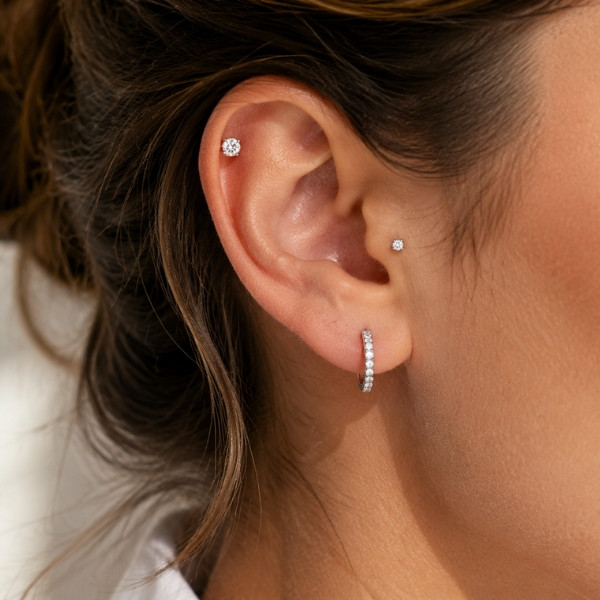
Mix a lab-grown diamond stud at the cartilage, a small hoop at the mid-helix, and a delicate huggie at the lobe for a modern, considered look. Keep metals within the same family for cohesion.
Weddings & Occasions
Platinum or 18ct white gold diamond studs at the cartilage read elegant and understated alongside drop earrings at the lobe — refined without competing for attention.
Everyday Wear
A lightweight 18ct gold hoop or huggie is comfortable enough to forget you're wearing — ideal for cartilage pieces left in continuously day after day.
Metal Harmony
An all-white stack (platinum and white gold) is sleek and contemporary; mixing warm gold tones across pieces creates a more relaxed, layered feel.
Minimalist Statement
A single solitaire lab-grown diamond cartilage stud in platinum, worn alone, is one of the most quietly confident pieces in fine jewellery.
For Him
Subtle platinum or white gold studs work brilliantly in men's diamond stud earrings — refined enough for the office, sharp enough for evenings out.
Browse Cartilage & Stud Earrings
Caring for Your Cartilage Earrings
Fine cartilage earrings deserve proper, consistent care — especially if you intend to wear them continuously for months at a time.
- Clean gently. Use warm water, a small drop of mild soap and a soft brush. Rinse thoroughly and pat dry with a lint-free cloth. Avoid alcohol-based cleaners on lab-grown diamond settings, as repeated exposure can affect certain finishes over time.
- Check the setting periodically. Even well-made studs can loosen slightly with continuous daily wear, sleeping pressure and general movement. A quick check every few months keeps stones secure and catches any issue early.
- Store pieces separately when not worn. Platinum and gold can mark one another even within a jewellery tray — separate compartments or soft pouches prevent unnecessary surface scratches.
- Remove before swimming or heavy product use. Chlorine, heavy hair products and contact sports all pose risks — either to the metal finish or to the earring becoming caught and pulled, which is a particular concern for cartilage.
- If irritation returns on a healed piercing, don't assume it's the piercing. Remove the earring and consult a piercer. In many cases, it's a product, a cleaning regime change, or — less commonly with fine hallmarked metals — a developing sensitivity worth investigating properly rather than dismissing.
Comparison Tables
Fine Metals for Cartilage Earrings — At a Glance
| Metal | Purity | Hypoallergenic? | Durability | Relative Cost |
|---|---|---|---|---|
| Platinum | 950/1000 | Yes — naturally | Outstanding | Highest |
| 18ct White Gold (nickel-free) | 750/1000 | Yes — nickel-free alloy | Excellent | High |
| 18ct Yellow Gold | 750/1000 | Yes — widely tolerated | Excellent | High |
| 18ct Rose Gold | 750/1000 | Yes — copper alloy, rarely reactive | Excellent | High |
| 9ct Gold | 375/1000 | Risk — higher alloy content | Good | Medium |
| Gold-plated | Variable (coating only) | No — wears to expose base metal | Poor for cartilage | Low |
New Piercing vs Healed Piercing — Metal Guidance
| Stage | Recommended Metal | Why |
|---|---|---|
| Brand-new piercing | Implant-grade titanium (ASTM F136) | Lightweight, highly biocompatible, professional standard for healing |
| Healing (0–6 months) | Titanium, or solid nickel-free 18ct gold / platinum | Body still adjusting; minimal irritant exposure is key |
| Fully healed (6–12 months+) | Platinum, 18ct gold (any tone), lab-grown diamond settings | Tissue settled, ready for long-term fine jewellery investment |
Frequently Asked Questions
Final Thoughts
If cartilage earrings have ever left you sore, itchy, or wondering whether your ears are simply "difficult", the answer is very often sitting in the metal rather than the piercing itself. Cartilage's slow healing and poor blood supply mean it has far less tolerance for nickel, plating, and low-purity alloys than the lobe does — and once you understand that, the solution becomes refreshingly simple.
Platinum and nickel-free 18ct white gold sit at the top of the list for genuinely sensitive ears, with high-karat yellow and rose gold close behind for the majority of wearers. What unites all of them is solid construction, high purity, and — critically — independent verification through UK hallmarking, so you're never relying on a seller's word alone.
Pair any of these metals with IGI- or GIA-certified lab-grown diamonds, and you get a piece that is not only kind to sensitive skin but also genuinely beautiful, consistent, and excellent value — something you can wear continuously for years rather than cycling through irritating fashion pieces every few months.
Browse the full diamond earrings collection, explore diamond stud earrings and hoop earrings, or book a consultation with the Sunshine Diamonds team if you'd like personal guidance on the right metal for your ears.